
Introduction to Java Collections
BackWhy do we need collections?
-
Most code is essentially about processing data, so how we store and operate on data is critical.
-
Arrays: fixed capacity, expensive insert/delete operations, and lack of rich, well-encapsulated APIs.
-
Collections framework: a unified set of interfaces, mature implementations (List / Set / Queue / Map), plus rich algorithms.
Result: code becomes easier to write and maintain, and there are dedicated thread-safe variants for concurrent scenarios.
What is a collection?
- A container for storing data
- Supports generics
- Provides unified abstraction interfaces
- Comes with rich APIs
- Often provides concurrent variants
Types of collections
The Java Collections Framework can be roughly divided into two main interface families. Under Collection there are three major branches, while Map does not extend Collection—it is a separate top-level interface (but still part of the collections framework):
-
Collection interface: single elements
- List: ordered sequence that allows duplicates
ArrayList: backed by anObject[]arrayLinkedList: backed by a doubly linked listVector: also backed by anObject[]array (legacy design, not recommended)
- Set: stores unique elements
HashSet: unordered, unique elements; backed by aHashMapLinkedHashSet: subclass ofHashSet, backed by aLinkedHashMap
SortedSet: ordered Set interfaceTreeSet: ordered and unique; backed by a red–black tree
- Queue: for processing elements in order
PriorityQueue: priority queue backed by a binary heap (min-heap by default)Deque: double-ended queue that can work as both a stack and a queueArrayDeque: backed by anObject[]arrayLinkedList: backed by a doubly linked list
- List: ordered sequence that allows duplicates
-
Map interface: key–value pairs with unique keys and potentially duplicate values
HashMap: hash table using chaining to resolve collisions; allowsnullkeys andnullvaluesLinkedHashMap: hash table + doubly linked list that preserves iteration order on top ofHashMap
Hashtable: older design with weaker performance (not recommended)SortedMap:TreeMap: backed by a red–black tree and ordered by key
ConcurrentHashMap:- Designed for high-concurrency, multi-threaded scenarios
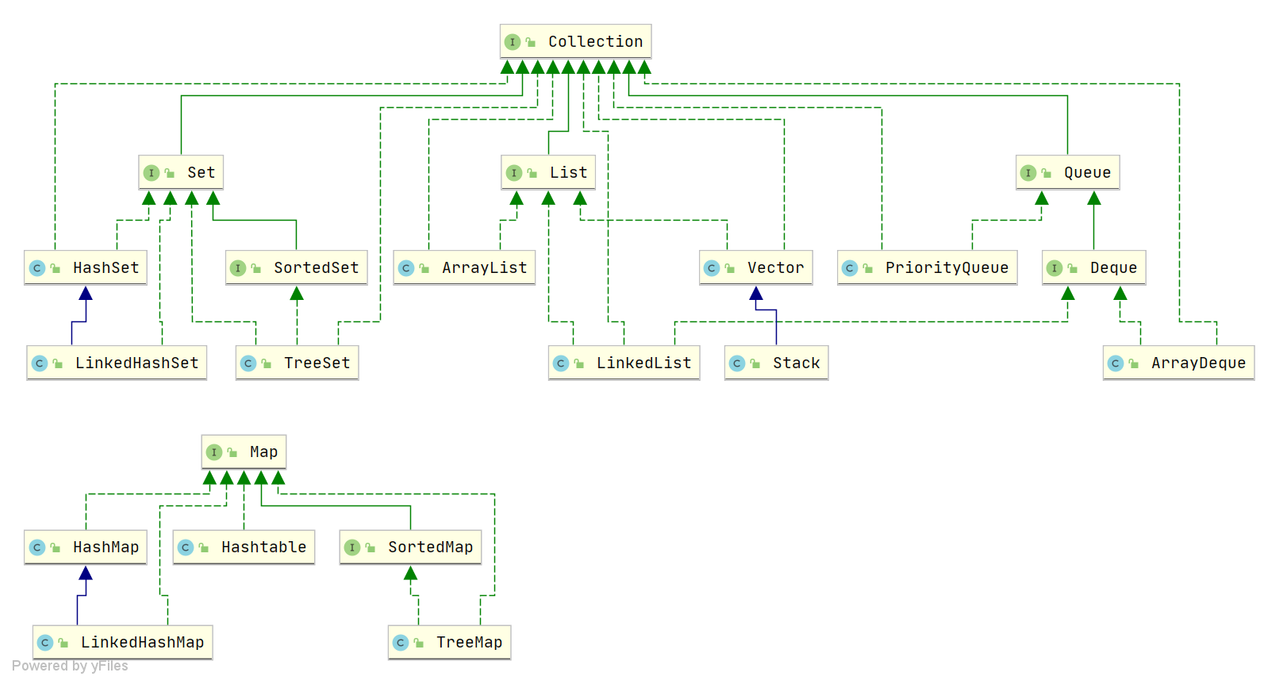 The above diagram is from the Javaguide website.
Usage scenarios
First, decide whether you need key–value mapping:
-
If yes, start with a Map:
- Use
TreeMapif you need sorted keys. - Use
ConcurrentHashMapif you need thread safety in high-concurrency scenarios. - In many other cases,
HashMapis the default choice.
- Use
-
If you only need to store elements (no keys), look at the
Collectionhierarchy:- Choose a
Setimplementation if you need uniqueness. - Choose a
Listimplementation if duplicates are allowed. - Choose a
Queueimplementation if you need queue or stack semantics.
- Choose a
flowchart TD
    A[How to choose a collection] --> B{Need key-value mapping?}

    B -->|Yes| M[Map]
    M --> MT{Need thread safety?}
    MT -->|Yes| CHM[ConcurrentHashMap]
    MT -->|No| MO{Need sorted by key?}
    MO -->|Yes| TM[TreeMap]
    MO -->|No| HM[HashMap]

    B -->|No| C[Collection]
    C --> CU{Need uniqueness?}
    CU -->|Yes| S[Set]
    CU -->|No| L[List]

    S --> SO{Need ordering?}
    SO -->|Yes| TS[TreeSet]
    SO -->|No| HS[HashSet]

    L --> AL[ArrayList]
    L --> LL[LinkedList]