
LeetCode Hot 100: 084 - Largest Rectangle in Histogram
BackGiven an array of integers
heightsrepresenting the histogram’s bar height where the width of each bar is 1, return the area of the largest rectangle in the histogram.
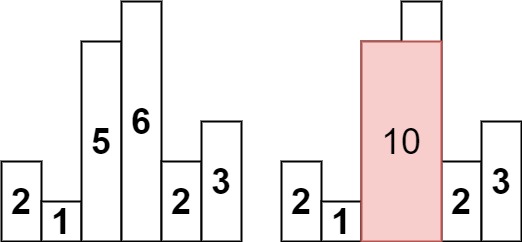
Idea: Monotonic increasing stack + sentinel trick
- Core idea: For each bar, find the maximum rectangle that uses it as the minimum height.
- Use a monotonic increasing stack (storing indices) to maintain bars whose right boundary hasn’t been found yet.
- When encountering a shorter bar, the right boundary of the top bar in the stack is determined, so we can calculate the area.
- Add a sentinel bar with height 0 at the end to ensure all bars are processed.
Time complexity: (O(n)), each index is pushed and popped at most once.
Java implementation
class Solution {
    public int largestRectangleArea(int[] heights) {
        int len = heights.length;

        // New array: add a sentinel with height 0 at the end to trigger final processing
        int[] newArray = new int[len + 1];
        System.arraycopy(heights, 0, newArray, 0, len);
        newArray[len] = 0;

        int ans = 0;
        // Monotonic increasing stack: store indices, ensuring newArray[bottom..top] is increasing
        Deque<Integer> stack = new ArrayDeque<>();

        for (int i = 0; i <= len; i++) {
            int cur = newArray[i];

            // cur is shorter: cur is the first bar to the right shorter than the top bar
            // The right boundary of the top bar is determined, calculate area
            while (!stack.isEmpty() && newArray[stack.peek()] > cur) {
                int mid = stack.pop();
                int height = newArray[mid]; // Use mid as the minimum height

                // leftLess: index of the first bar to the left shorter than mid; -1 if none
                int leftLess = stack.isEmpty() ? -1 : stack.peek();

                // width = right boundary (i-1) - left boundary (leftLess+1) + 1 = i - leftLess - 1
                int width = i - leftLess - 1;

                ans = Math.max(ans, height * width);
            }

            // Push to stack, maintain monotonic increasing (wait for a shorter bar to process)
            stack.push(i);
        }

        return ans;
    }
}
Array copying methods
System.arraycopy (most common, fastest, low-level optimized)
Suitable for: copying a segment of one array to another (including copying after expansion)
int n = heights.length;
int[] a = new int[n + 1];
System.arraycopy(heights, 0, a, 0, n);
a[n] = 0; // sentinel- Copies element references/values (int is a value)
- For object arrays, it’s a shallow copy (only copies references)
Arrays.copyOf (best for “expand and copy”)
Suitable for: the most common “copy and expand to new length” scenario in competitive programming
import java.util.Arrays;

int[] a = Arrays.copyOf(heights, heights.length + 1);
a[heights.length] = 0;- Concise and semantically clear
- Internally uses efficient copying